
Small-business outsourcing research
Research: Topic Queue Diversity in Small-Business Outsourced Publishing
How to test whether a daily article queue expands useful coverage instead of repeating the same outsourcing decision in new words.
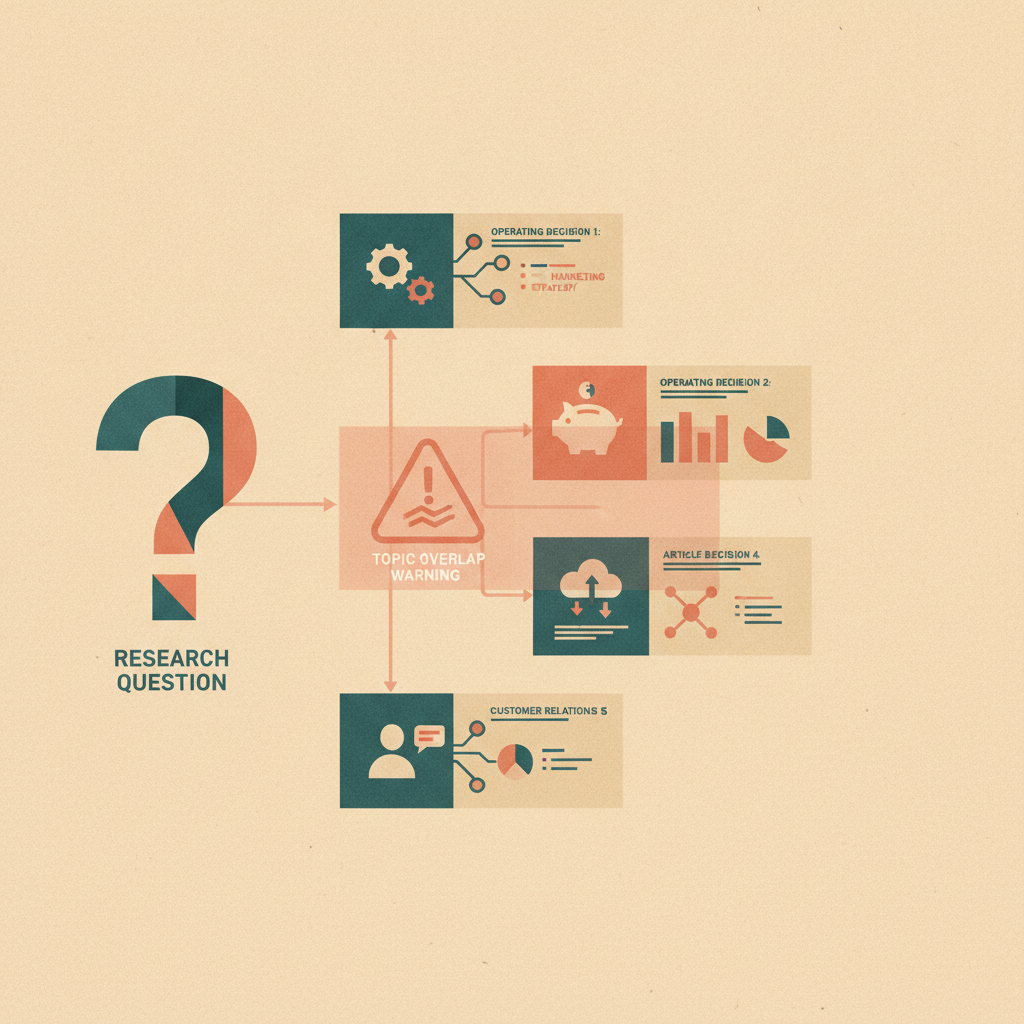
Research question. Does a small-business article queue cover distinct operating decisions, or does it repeatedly rename one outsourcing idea while creating the appearance of breadth? The unit is a proposed article topic linked to a reader decision, evidence need, service lane, and existing-content comparison. The study is not a search-volume exercise. It asks whether daily publishing gives an owner or operator new help with choosing, scoping, reviewing, or governing outsourced work.
Methodology and evidence scope. Sample topics proposed during one campaign period and map each to its primary question, audience, service context, risk, source type, and closest existing page. Code overlaps as title overlap, thesis overlap, example overlap, decision overlap, or merely shared vocabulary. Inspect both accepted and rejected topics so the queue does not hide the work of avoiding duplication. Google’s helpful-content guidance, SBA planning and management guides, NIST CSF 2.0, and FTC security guidance supply context for people-first usefulness, business planning, risk, and information handling. Sources: https://developers.google.com/search/docs/fundamentals/creating-helpful-content; https://www.sba.gov/business-guide/plan-your-business; https://www.sba.gov/business-guide/manage-your-business; https://www.nist.gov/publications/nist-cybersecurity-framework-csf-20; https://www.ftc.gov/business-guidance/resources/start-security-guide-business.
Facts versus analysis. A topic title, existing URL, stated question, source set, and overlap category are facts when recorded. The conclusion that two articles are materially distinct is analysis. Shared words such as outsourcing, review, handoff, or small business do not establish duplication by themselves. Conversely, different nouns can conceal the same thesis if every article tells the reader to document the task, limit access, and keep owner approval without examining a new decision. Reviewers should compare treatment and examples, not only strings.
Queue diversity is not random variety. A useful portfolio can revisit a service lane from a different evidence question, such as access risk, exception handling, or measurement, while preserving a clear reason for the new article. Diversity means the reader can identify a different decision or a sharper boundary. It does not require every article to be unrelated. The research record should therefore preserve the relationship between a new topic and its neighbors: complement, update, narrow study, or reject. Without that relation, publishing teams may mistake novelty of phrasing for novelty of usefulness.
For OutsourcingSmallBusinesses.com, the audience is evaluating Philippines-based support and daily operating routines. Topic selection should make that context central rather than attaching it in a final paragraph. A topic about content review, for example, should examine the evidence an owner needs before delegating research or drafting. A topic about bookkeeping should examine source reconciliation and judgment boundaries. A broad article about productivity may be relevant to many companies but still fail this site if it does not help the intended reader decide what work can safely move and how the result will be reviewed.
An outsourced researcher can build the comparison map, find candidate sources, flag likely cannibalization, and explain why a topic appears distinct. The owner or editor decides whether the topic fits the publishing strategy, whether it should update an existing page instead, and whether the proposed thesis is sufficiently useful. The support role should not force a new URL to meet a daily count. A rejected topic is a valid queue outcome when the evidence shows that the best reader experience is a stronger existing page or a later study with a clearer question.
Measure the queue with coverage and overlap together. Track distinct decision categories, service lanes represented, high-risk topics reviewed, rejected duplicates, accepted topics later merged, and the share of articles whose primary question was recorded before drafting. A large topic count can still have narrow coverage. A low overlap rate can reflect an overly permissive taxonomy. Review the underlying map and publish the measure only as internal evidence. Public copy should describe the reader problem and research conclusion, not the mechanics of the queue.
Test the method with close pairs. Compare an article about content brief source quality with one about correction loops; an article about customer inbox routing with one about response boundaries; or an article about scheduling capacity with one about appointment exceptions. Ask whether the second piece changes the decision, evidence, examples, and conclusion. If it only changes the vocabulary, reject it. If it examines a new risk or a different point of authority, keep both and make their relationship explicit in the internal map.
Limitations. This is a qualitative portfolio method, not a measure of audience demand, search ranking, traffic, conversion, or revenue. The judgment of material difference can vary between reviewers, especially when two topics share a service lane. Public guidance cannot determine the best editorial portfolio for a particular business. A queue can be diverse and still miss a critical audience question. The sample also cannot prove that every accepted article will remain useful after tools, policies, or operating conditions change.
Evidence-led conclusion. A topic queue is genuinely diverse when each accepted article has a distinct research question, decision, evidence scope, and treatment that survives comparison with the existing corpus. The evidence supports recording close neighbors and rejecting rename-only ideas before drafting. It does not support using different slugs or dates as proof of originality. For daily outsourced publishing, breadth should be measured by the decisions a reader can make after reading, not by the number of pages added to the library.
Owner review questions. What new decision does this topic support? Which existing page is closest, and why is an update insufficient? Does the title promise a different thesis than the body delivers? Are the examples grounded in small-business outsourcing rather than generic productivity? Which role boundary or risk is being studied? These questions let the owner approve a smaller, more coherent queue while giving support a precise reason for researching or rejecting a candidate.
Further interpretation. The most dangerous overlap is often structural rather than verbal. Five articles may use different titles but repeat the same sequence of finding, checklist, access warning, owner approval, and conclusion. A comparison map should therefore record the evidence type, the counterexample, and the decision point in addition to the title and slug. This makes it possible to distinguish a research article from a generic workflow or a blog article with citations appended. A mature queue also preserves unresolved gaps. If the existing corpus covers task scoping but not how an owner evaluates post-publication corrections, the gap can be stated plainly and scheduled when sources and expertise are available. The support role can surface the gap; the owner decides whether it matters more than another routine topic. This approach reduces pressure to manufacture novelty while keeping daily production active. The research answer is that queue diversity is an editorial control: it protects reader attention, improves coverage of real outsourcing decisions, and makes the eventual article set easier to govern.
Closing conclusion. A smaller queue with clear separations is more defensible than a larger queue of near-duplicates. OutsourcingSmallBusinesses.com can use one distinctness record per candidate, a close-pair review for risky topics, and an explicit reject disposition. Those controls keep the mission focused on proper daily article creation and help the site accumulate evidence-led coverage instead of a pile of interchangeable pages.