
Small-business outsourcing research
Research: Publication Readiness Evidence for Outsourced Small-Business Content
What a reviewer should be able to prove before an outsourced article is allowed to represent the business publicly.
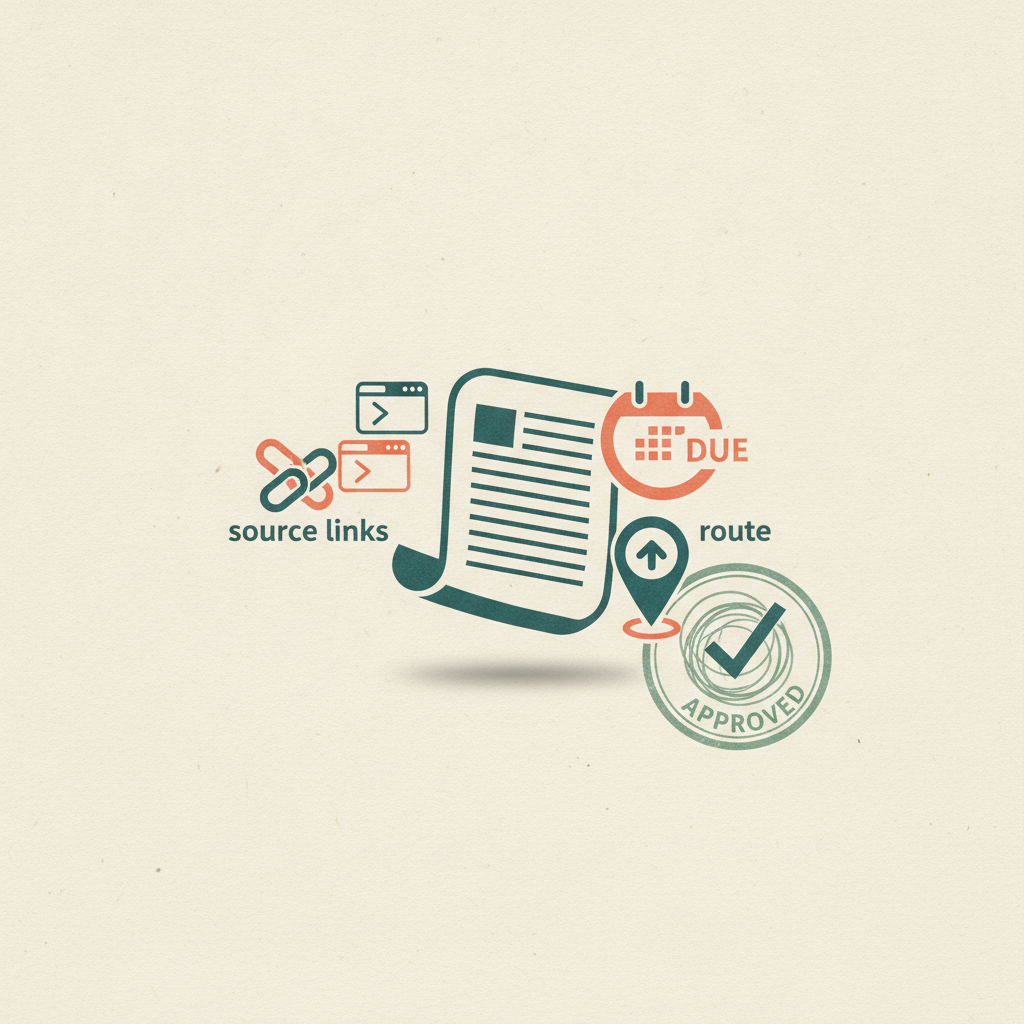
Research question. What evidence should a small business require before an outsourced article moves from a draft into public publication? The unit is one article record, including its intended reader decision, source set, date, canonical identity, body, image, and approval state. The study asks whether readiness means more than polished prose. A publication-ready article should be truthful, relevant to the site’s outsourcing niche, distinct from neighboring pages, correctly dated, and clear about what a support role can prepare versus what an owner must decide.
Methodology and evidence scope. Define a readiness sample from one campaign and inspect each record against five dimensions: identity, evidence, editorial fit, public safety, and rendering. Identity includes the route, title, date, canonical URL, and family. Evidence includes claim-source connections, methodology, limitations, and conclusion. Editorial fit includes a genuine research question, niche-specific examples, and separation from Blog content. Public safety includes unsupported company facts, commercial claims, and sensitive details. Rendering includes visible date, structured date, image path, index entry, and sitemap presence. Google helpful-content guidance, SBA business guides, NIST CSF 2.0, FTC security guidance, and the Copyright Office overview provide public context. Sources: https://developers.google.com/search/docs/fundamentals/creating-helpful-content; https://www.sba.gov/business-guide/plan-your-business; https://www.nist.gov/publications/nist-cybersecurity-framework-csf-20; https://www.ftc.gov/business-guidance/resources/start-security-guide-business; https://www.copyright.gov/circs/circ01.pdf.
Facts versus analysis. A route, literal date field, rendered time element, source URL, word count, and image file are inspectable facts. The judgment that the article is useful and original is analysis supported by comparison and review. A page can pass a build while failing its audience, and it can have many sources while making an unsupported leap. Readiness should therefore be a conjunction, not a single score. If one required dimension is unresolved, the record should say that it is not ready rather than allowing a green status to hide a red boundary.
Identity checks protect the reader and the site. The article must have one stable route that has not been borrowed from an older page, one visible title, one direct publication date, and a canonical URL on the same site. The family should be clear so research is not presented as a blog post or a service landing page. Deterministic ordering matters because same-day records need to appear predictably in the index. These checks are technical, but their editorial purpose is simple: the reader should know what they are reading and when it was published.
Evidence checks ask a narrower question than “does this look researched?” The reviewer should identify the article’s research question, the evidence scope, at least three reputable external URLs, the difference between fact and analysis, limitations, and an evidence-led conclusion. A source list appended after a generic workflow does not satisfy the question. The body must use the sources to reason about a real small-business outsourcing decision. If evidence is mixed, the article should narrow its conclusion. Caution is stronger than an unsupported benchmark presented as certainty.
Role boundaries are part of readiness. A Philippines-based specialist may research, compare records, draft an article, and flag uncertainty. The business retains approval of public claims, legal or financial meaning, customer promises, commercial terms, credentials, results, and material changes to the publishing direction. An article that describes support as if it can make those decisions is not ready even when the prose is accurate. The readiness review should therefore inspect who is implied to act, what authority is assumed, and whether the conclusion keeps the decision with the appropriate owner.
Measure readiness by defects and disposition. Track articles accepted first pass, narrowed before publication, rejected as duplicates, returned for source work, returned for public-safety concerns, and corrected after publication. Report counts with the sample denominator and keep content changes separate from infrastructure changes. A faster review can indicate better briefs, but it can also mean the reviewer skipped a dimension. A useful sample includes difficult articles and withheld drafts, because a readiness gate that never stops anything is likely a decoration.
Scenario testing should include a date mismatch, a broken source, an article that overlaps a Blog page, an image with an uncertain path, and a draft that includes an internal production detail. The reviewer should be able to identify the exact failure and route it to a bounded repair. The support role can collect the evidence and prepare a correction. The owner or editor decides whether the repair preserves the thesis, whether the article should be withdrawn, and whether a public statement needs to change. This keeps a readiness gate from becoming an unowned checklist.
Limitations. This framework is an operational review model, not a legal clearance, accessibility audit, copyright opinion, search-ranking prediction, or guarantee of factual completeness. A build proves that code compiles and routes can render; it does not establish that a claim is supported. External sources can themselves change, and a reviewer can miss a subtle overlap. The dimensions may need adaptation for a different family or subject. High-risk financial, legal, medical, privacy, or regulated claims require qualified review beyond this article’s scope.
Evidence-led conclusion. Publication readiness is proven when the reviewer can inspect identity, evidence, niche relevance, role boundaries, and rendered output together. The evidence supports a stop condition for unresolved date, source, originality, safety, or route issues. It does not support treating a clean build or a polished draft as sufficient. For a daily outsourced article routine, the most useful readiness record is a small set of measured checks that keeps the owner accountable for the public result while letting support handle repeatable preparation.
Owner review questions. What exact reader decision does the article improve? Which claims have direct sources? Is the conclusion narrower than the evidence or broader? Does the page make any company fact, result, price, or credential claim that was not supplied? Can the date and canonical identity be inspected on the route? What happens if the article is returned? These questions focus approval on public truth and audience usefulness rather than on the volume of drafts waiting in a queue.
Further interpretation. Readiness is not an attempt to remove judgment from publishing. It is a way to make judgment visible at the right point. A reviewer can verify that the record has a clear question and sources, but an owner must decide whether the subject deserves publication now, whether the article’s tone fits the business, and whether the conclusion respects the company’s service boundaries. The same evidence also makes delegation safer. Support can prepare a complete packet without silently publishing or converting an unresolved issue into a final claim. If the packet repeatedly fails on dates, the remedy may belong in the loader; if it fails on niche relevance, the remedy may belong in the topic brief; if it fails on public safety, the remedy may be a clearer boundary. Treating all defects as writing problems wastes review time. A small pilot can compare first-pass acceptance and correction reasons across one week, but it should not be interpreted as proof of universal quality. The research answer is that readiness is a chain of evidence, and the chain breaks at its weakest unresolved link.
Closing conclusion. OutsourcingSmallBusinesses.com can protect a daily publishing routine by making “ready” mean inspectable rather than merely finished. One article should carry its own date, identity, sources, thesis, limitations, role boundary, and rendering evidence. That gives the owner a meaningful approval point and gives the support team a repeatable preparation standard without exposing internal production mechanics to readers.